


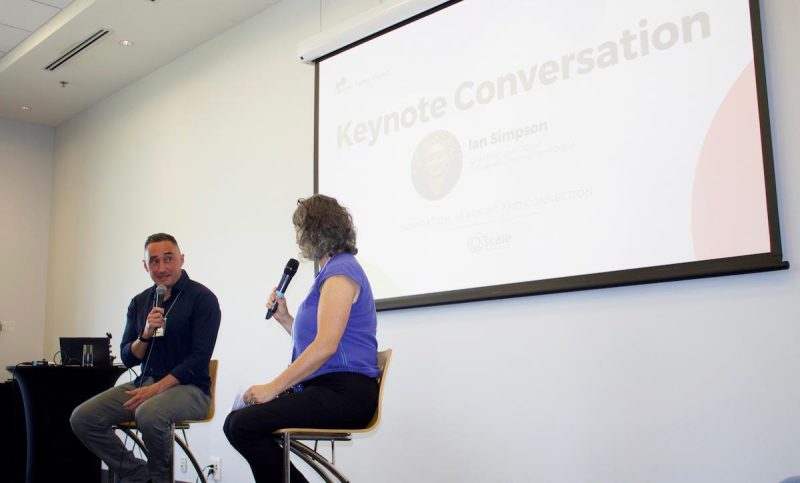
Ian Simpson, CEO of Petroglyph Development Group, speaks with Kristi Fairholm Mader, Managing Director of Thrive Impact Fund, during a keynote conversation at Connect Money Impact Nanaimo 2026.
Seven years ago, a conversation began in Nanaimo that aimed to shift how we think about money and community in BC. The goal of Connect Money Impact (CMI), a regional gathering for social entrepreneurs, impact investors, and ecosystem builders, was straightforward: deploy capital to serve the people bringing solutions to the hardest challenges in community.
Since that first CMI in Nanaimo, hosted in subsequent years in both Victoria and Kelowna several times, there has been genuine, measurable traction in the impact investing sector. At Thrive Impact Fund, we’ve built an initial $10 million impact-first fund and put 25+ investments into social enterprises and social purpose organizations making an impact in British Columbia. In our backyard, we have seen the launch of impact funds like GrowthWorks and Goparity Canada. Nationally, institutional milestones are being reached, such as Realize Capital Partners closing their Realize Fund I, and Raven Indigenous Capital Partners raising several funds. This signals the growth and shift towards scaling the sector.
The need for a strong impact investing and social finance sector is evident
Recently, Thrive Impact Fund provided a loan for a stable, deeply rooted local charity with a 40-year operating history. They own an asset worth about $2 million, with close to $250,000 of debt remaining. Because of a single year of net loss, an understandable blip caused by temporary operational shifts, their financial institution denied their mortgage renewal. We assume that the financial institution wanted to continue the loan, but their risk-assessors wouldn’t allow it. If Thrive hadn’t stepped in, the organization would have needed to sell their property, and the community would have lost core services like childcare and parent support groups.
A 40-year-old organization with an asset worth five times its liability was turned away over an off-year. It’s wild. And it clearly demonstrates why social finance organizations like Thrive, Raven, Realize, GrowthWorks and Goparity are critical to step into the gap.
There are two stories here; one of the barriers to income and assets that communities and social enterprises encounter (and the right kind of capital required), and the other is a call to scale the social finance organizations and sector working to close these gaps.
If we want to see what economies looks like when a community takes control of its own assets, we don’t have to look far. Look at the incredible blueprint being highlighted right now by leaders like Ian Simpson, CEO of Nanaimo’s own Petroglyph Development Group, which has scaled from $15 million to nearly a billion dollars in assets under management.
As Ian puts it, this isn’t an act of “inclusion” into someone else’s system; it is an expression of inherent jurisdiction and sovereignty.
Petroglyph’s massive scale wasn’t built on traditional debt alone. It was supported by a historic, systemic shift: the return of thousands of hectares of traditional territory and crown lands back to the Snuneymuxw First Nation. That returned land base became the invaluable collateral, paired with strategic investments in hospitality and gaming, that allowed them to leverage and build a powerhouse economic engine on their own terms. It was also made possible by a mindset shift, strong leadership, willingness to take risks, and access to the right kind of capital.
It is an inspiring model of sovereignty. But it is also a model that is nearly impossible for the rest of the social economy to replicate under the current rules of finance.
Most non-profits, housing co-ops, and social enterprises do not have a deep asset base on their balance sheets, nor do they have access to highly profitable revenues. Many are starting from much less on the equity and income ledger.
And that is where the system breaks
If we want the rest of the social economy to achieve the kind of self-determination we see in sovereign Indigenous economies, we can’t keep asking underfunded non-profits to bootstrap their way to scale. We have to build the missing financial scaffolding intentionally. As Thrive looks at scaling our model from $10 million toward a target of $25 to $50 million, we are becoming acutely aware of the structural limitations standing in the way of funds like ours and the organizations we invest in.
We are a debt fund, and debt is useful. We often go in early before traditional lenders to finance a project, taking on the initial risk so that larger, more conservative capital can come in later once a project or organization can meet their criteria.
Loans are an important financial tool and many businesses grow because of the patient and risk-tolerant nature of equity. Without this patience, even the most sophisticated charities and enterprises in BC are hindered in their growth because they lack access to flexible, patient, base-layer equity. These organizations that are working on some of the hardest problems on the planet don’t have an extra 5% or 10% of unencumbered cash in their models that is needed to unlock development capital or complete an acquisition.
Further, traditional equity models often don’t work for the social economy. Venture capital looks for hockey-stick growth and one or two successes that balance the losses of others. A regional housing project or a local food system is not aiming to produce a 10x return, nor should it. And non-profits and charities cannot issue equity, regardless. So, how do we strengthen the options for patient, flexible and risk-tolerant capital?
One of the solutions we are trying to imagine is a framework for ‘equitable equity’.
This is a tier of capital designed for community wealth retention rather than shareholder extraction. Capital that values stable, long-term yields and deep community returns. This type of capital has long time frames, preserves cash in early years, incorporates revenue or wealth sharing, and comes in as partners willing to risk alongside. Grants play a role here, as well as caring capital invested into funds that then can take this approach. We need to shift who owns the returns, who sets the expectations, and who dictates the terms.
As observers of the federal Social Finance Fund have rightly pointed out (take a look at Diane Berard’s story on it in Future of Good), the real reckoning comes after 2030 when the public anchor money disappears. The true test will be whether we’ve built a durable, self-sustaining market, or if we’ve just rented one for a few years. A few hundred million dollars allocated to social finance across Canada is a solid milestone, but in a global economy where multi-billion-dollar pension funds move markets daily, there’s room for growth…
Let’s return to the transferable lessons from Ian Simpson’s story: mindset shift, strong leadership, willingness to take risks and the right kind of capital.
The social finance sector needs to think and act big, and employ the same pillars of success, like having a real, risk-tolerant equity base, that Ian’s team leveraged so effectively. We need to support entrepreneurs leaders across the eco-system, and provide pathways for Boards to support that leadership. And the right kind of capital is emerging– we just need more of it.
To ensure we build a self-sustaining social economy that lasts long after the public anchor money steps back, the challenge cannot be carried by any single group on their own:
- For investors: It means moving past the comfort of automated, rigid risk models and recognizing that true impact requires adjusting our expectations around returns. If we want to solve systemic crises, we have to start funding the base-layer, patient equity that organizations actually need to scale.
- For social entrepreneurs: It means moving beyond a reliance on grant mentalities or simply trying to survive within the current rules. We need to focus on rigorous asset management and design our enterprises to actively build and retain collective equity.
- For ecosystem builders: It means moving the conversation towards applied capacity-building and deep working connections. We need to focus heavily on protecting community assets, helping organizations navigate the capital gap and building the regional networks that can pool and deploy resources that meet the needs of local communities